
Where Pressure Ultimately Lands
In the last series, we looked at how organizations behave under sustained pressure.
Leadership involvement expands as stakes rise. Product strategy starts absorbing uncertainty from other parts of the system. Go-to-market teams respond to urgency in ways that can quietly steer the company’s direction.
The pattern across all of it is structural. Pressure exposes how organizations actually work — where judgment lives, how decisions get made, and which parts of the system absorb uncertainty when expectations climb.
But there’s another layer to this dynamic. One that only becomes visible once you understand the organizational patterns.
Pressure doesn’t just reshape operating models. It reshapes the leaders inside them.
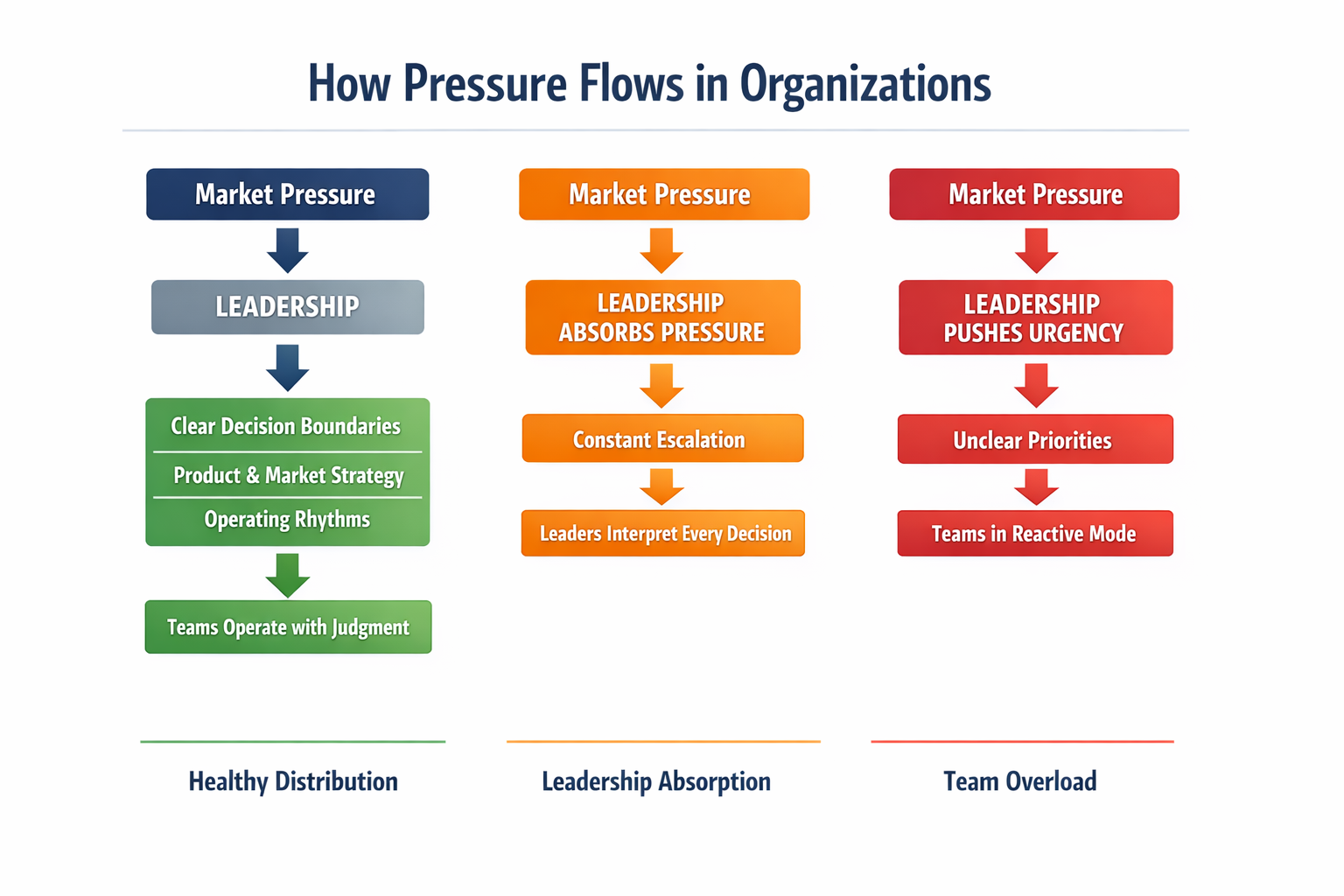
When organizations are designed to distribute judgment effectively, pressure moves through the system. Teams keep making decisions close to the work. Leadership stays focused on direction and coherence.
When those structures are less clear, pressure starts collecting around individuals. Leaders become the place where signals get interpreted, tradeoffs get resolved, and accountability ultimately lands.
Over time, this changes how leaders behave. They absorb pressure personally. They move closer to operational detail. They spend more energy stabilizing the system than guiding it.
This series explores that layer.
We’ll look at what happens when leaders become the pressure valve for their organization, how to recognize when pressure is concentrating at the top, and how operating models can distribute it more effectively.
Pressure isn’t something leaders eliminate. It’s a permanent feature of the organizations they lead.
The real question is where it ultimately lives.
