
How Leadership Teams Distribute Pressure Instead of Absorbing It
Blog 4 of 4 in this series
Pressure doesn’t disappear as organizations grow. Expectations rise, markets move faster, and decisions carry more weight.
The difference between organizations that handle pressure well and those that struggle is rarely the amount of pressure they face. It’s where that pressure gets absorbed.
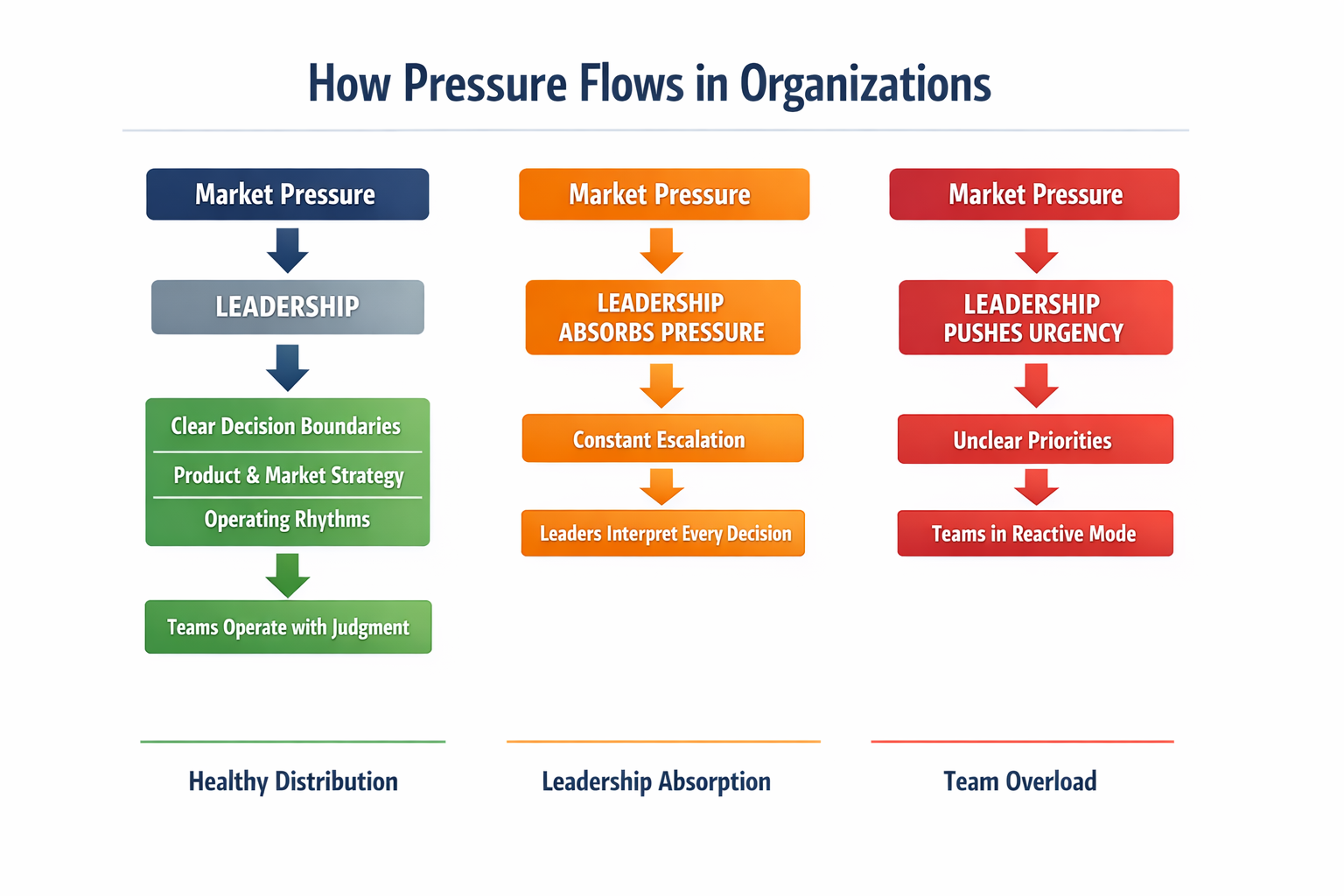
Three ways pressure can move through an organization and what each looks like in practice.
A few structural elements make the biggest difference.
Clear decision boundaries.
Teams understand where authority sits and when escalation is actually necessary. Pressure doesn’t automatically flow upward — it gets resolved at the right level. Leaders can stay focused on what only they can do.
Anchored product direction.
Product strategy is tied to a small number of durable priorities that hold under scrutiny. When the market shifts or customers push, the team has something stable to reason from. The roadmap doesn’t bend at every signal.
Go-to-market clarity.
Revenue signals reinforce strategic direction instead of distorting it. The sales team and the product team are reading from the same map. Urgency gets channeled rather than amplified.
Operating rhythms.
Regular product, revenue, and leadership reviews surface issues early — before they become escalations. The system self-corrects without waiting for a crisis. Leaders aren’t hearing about problems for the first time in a board meeting.
Leadership alignment.
Product, revenue, and executive leaders are reinforcing the same operating assumptions. There’s no arbitrage between functions — no version of the strategy that shifts depending on who you’re talking to.
When these elements are present, pressure flows through the organization rather than collecting at the top. Leaders still feel pressure. But they don’t carry it alone.
Pressure will always reveal how an organization actually operates. The question is whether the system was designed to hold its shape when it does.
NextPeak Studio works with executive teams who want to build operating models that distribute pressure rather than concentrate it. The elements described in this post — decision boundaries, product anchors, go-to-market clarity, operating rhythms, and leadership alignment — are the foundation we work from.
Our engagements focus on making those elements explicit and resilient across the leadership system. The goal is not to design an organization that avoids pressure, but one that continues exercising judgment when pressure increases.
If your organization is ready to move from absorbing pressure to distributing it, we help teams bring coherence and durability back to how decisions get made.
